The Ordeal of Jack Robbins
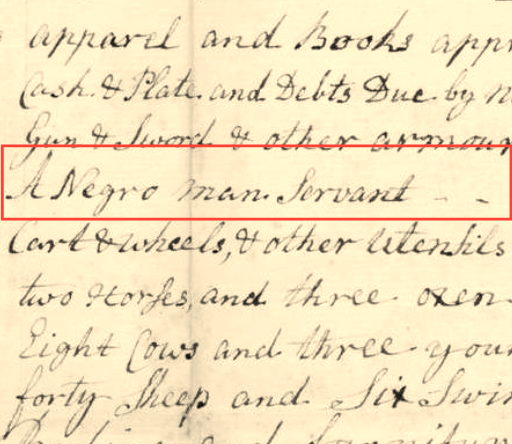
When Jack Robbins arrived in Walpole, he found himself “at the center of public life.” It wasn’t simply the endless stares and constant chatter the Black newcomer aroused among the predominantly white, rural townspeople. Rather, he lived and worked in a lively tavern at the center of town. Established in 1737 by the man who now enslaved him—one Ezekiel Robbins, deacon of the First Church of Walpole—the Brass Ball Tavern was often a site of public gathering, always a house of learning. Patrons read aloud the latest newspapers to a restive crowd. Travelers passed through for respite and refreshment. Huddled around the long, narrow tables of pine or maple or mahogany, they mingled with lubricated locals hungry for conversation and gossip and news, before going about their way or retiring for the night—taverns doubled as inns.[i]
Jack encountered traveling men, women, and children of all kinds at the Brass Ball. Records of some of the white, wealthier men’s visits have been preserved in their diaries. So we learn that, returning from Bristol in 1742, Boston Judge Benjamin Lynde dined at the tavern, perhaps treated to some seethed cod or boiled Jerusalem artichokes. Two years later Scottish physician Alexander Hamilton dropped in while traveling through the mainland colonies. Possibly Jack cooked for Judge Samuel Curwen of Salem who, on his way from Cambridge to Philadelphia in 1755, “alighted at Robbins, Walpole,” where he “dined on Eggs boil’d.” (Of the judge’s noontime dinner, one antiquarian has quipped: “This is scarcely the kind of meal we would expect one who had ridden out from Cambridge to order; yet, in charity, we will assume that it was what the Judge really wished for, and not the best fare the Deacon had to offer.”) More numerous, however, were proletarian travelers—families looking elsewhere for a fresh start, small-time farmers securing provisions, transients, laborers of all sorts—patrons who, in Dr. Hamilton’s estimation, displayed much too little regard for their social betters.[ii]
Visitors were not only socioeconomically diverse but plentiful; colonial Walpole, though rural, was far from isolated. The Brass Ball was conveniently located along the Post Road—“the great Road leading [from Boston] to Rhode Island”—which in the latter half of the eighteenth century, “developed … into one of the most heavily traveled roads in the country.” Returning to New Haven from Boston in 1771, William Gregory “arrived at Walpole just at dark, [where] I put up at one Mr. Robins’, just nineteen and a half miles from Boston, as far as I wanted to ride to divide the way between Boston and Providence.” The number of stagecoaches stopping by the Brass Ball increased as the century wore on, ferrying passengers between these busy port cities. The Post Road’s tavern keepers—people like Ezekiel Robbins—“doubtless did a flourishing business.”[iii]
Jack undertook an impressive array of tasks. He prepared and served drinks, warmed over a blazing fire (drinks were served hot in those days). Meals, too. (Certainly patrons had more options for their two o’ clock dinner than Judge Lynde’s “eggs boil’d.”) Many ingredients were sourced directly from the Robbins farm, where Jack would milk cows, churn butter, process wheat, stack hay, sow turnips, hill corn, thrash oats, and much more besides. Molasses, distilled into the rum Jack served—and a good deal of the rum itself—was extracted from the blood of enslaved Africans in the West Indies who formed the backbone of New England’s economy. Jack cut a great deal of wood to fuel the never-ending fires he constantly attended lest his patrons freeze. For boarders, he laundered linens and maintained sleeping quarters. Incessant cleaning, of course, was involved in every aspect of the work.[iv]
Pile on the emotional labor Jack was subjected to. Walpolians remember Jack for expelling rowdy patrons from the tavern’s confines. Two centuries after Jack’s arrival in town, Ezekiel’s descendent Dana Robbins recalled: “He was a large, powerful fellow in his prime and of great assistance about the Tavern in subduing noisy and unruly guests. It is said that when called upon to clear the room he would do so in a faultless style.” The memory strikes at a distressing recurrence in Jack’s life: confronting violent, intoxicated white men as an enslaved African in a thoroughly anti-Black society. The memory likewise suggests that Jack pushed back—and did so forcefully. It was, by any measure, a delicate balancing act.[v]
The recollection hints at something else, too: that Jack, an enslaved African, possessed some authority over white patrons. This “delegated, earned authority of expertise and experience” likely extended to laborers Ezekiel hired to work alongside Jack in the tavern or on the farm. Still, Jack’s authority was confined, and of course, no measure of experience or expertise would alter his inferior legal and social status.[vi]
Of Jack’s work on the Robbins farm, Walpolians have passed down a single story:
[Jack and the Deacon] were getting in hay on a certain occasion, he pitching on and the Deacon building the load. Jack did not exert himself enough to suit his master, who reprimanded him. Without answering, Jack began pitching on the hay so fast that the Deacon, who was short and stout, was soon overwhelmed and slid off the load. As he came to the ground Jack asked: “What yo’ down heah fo’, Massa? Mo’ hay?”[vii]
It should first be noted that Jack did not speak in this stereotypical dialect, long used disparagingly to represent Black people’s speech. We don’t quite know how Jack sounded; if born in Massachusetts, he likely spoke in a style similar to that of many white colonists. In any case, no matter the accent, white people felt no urge to transcribe one another’s words in a like manner. Most importantly, explains historian Annette Gordon-Reed, such caricatured renditions of African Americans’ speech “reinforce the notion of Blacks as ‘the other’ and Whites as ‘normal’ or ‘standard,’” and distract from the substance of Black people’s words.[viii]
The anecdote is nevertheless informative. Perhaps Jack’s quip lightened the mood, saving him from a brutal beating. Or perhaps Ezekiel believed his question was serious: Jack may have been playing dumb to mask his aggression—a tactic often employed by enslaved people, who took advantage of whites’ racist assumption of their intellectual inferiority. Possibly the deacon didn’t quite know what to make of Jack’s riposte: “under the violent restrictions of slavery and segregation, African Americans developed the art of tendentious jokes so well, that they often left whites with the baffled general feeling that [they had] been lampooned [before their very eyes] without quite knowing how.”[ix]
For the enslaved, “Humor provided a balm, a release for anger and aggression, a way of coping with the too-often-painful consequences of racism.” And in all likelihood, the Africans Jack told the account to perceived it much differently. In the story, slave Jack appears in control and competent; master Ezekiel, inept and blundering. Seen this way, the account ridiculed the notion of white superiority. Indeed, for Jack and his fellow Africans, “the salient function of [such] jokes was to rob the American racial system of any legitimacy long before the courts or government began that still uncompleted task.”[x]
At times, Jack may have leveraged his position at the tavern to his advantage. Africans in Massachusetts frequently attended gatherings, sometimes among themselves, sometimes alongside others. Often, such affairs were lubricated: parties congregated at taverns or purchased alcohol from drinksellers who, though prohibited from selling alcohol to people of color, often looked the other way in pursuit of profit. In 1703, because (according to the wealthier white colonists) “great Disorders, Insolencies and Burglaries are oft times raised and committed in the Night-time by Indians, Negro and Mulatto Servants and Slaves, to the Disquiet and Hurt of Her Majesty’s good Subjects,” the Massachusetts General Court prevented slaves from being out past nine o’clock at night. The law was ineffective, so towns enacted their own ordinances. Boston continuously did so throughout the eighteenth century. Their efforts were to no avail; the nighttime revels continued.[xi]
But enslaved Africans need not have been in the bustling port city of Boston, where they had strength in numbers, to congregate. They gathered in rural towns, too—home to much smaller Black populations. In 1739, the “principal slave-owners in Roxbury” protested that “it hath been too much the unhappy practise of the negro servants of this town to be abroad in the night at unseasonable hours to the great prejudice of many persons or familys as well as their respective masters.” Surely these enslavers were astounded when they read of this shocked “gentleman’s” experience in the Boston Evening-Post the following year: “Last Friday a gentleman of this town went over to Roxbury to look for his Negro woman, who had been gone from him a few days, and hearing a noise in the tavern, he went in, past nine o’clock and found about a dozen black gentry, he’s and she’s in a room, in a very merry humour, singing and dancing, having a violin and a store of wine and punch before them. They all belonged to gentlemen in this town, and ’tis much to be wondered at, how they can be absent from their respective masters without their masters’ knowledge.” Such frolics occurred even in rural towns farther away from Boston. In 1760, when a young John Adams arrived at a Wrentham tavern to meet friends, he was repelled at the scene he encountered: “Negroes with a fiddle, young fellows and girls dancing in the chamber as if they would kick the floor thru … fiddling and dancing of both sexes and all ages, in the lower room, singing, dancing, fiddling, drinking flip and toddy, and drams.”[xii]
Ezekiel Robbins benefited tremendously by enslaving Jack. Forced labor was reliable; hired workers came and went. Having Jack take the primary role on his property allowed Ezekiel to devote more time bolstering his own career as a public servant, managing affairs of town and church, securing his legacy. Moreover, the deacon and his wife were aging and in need of assistance on the farm and in the tavern. Particularly worrisome for Ezekiel and Mary was that they had no children or grandchildren to care for them in old age. Enslaving Jack resolved these issues: he would care for them when they became sick or infirm, and they could enjoy their later years in peace. With Jack’s labor, Mary could keep up the lifestyle she had been living after Ezekiel died. On the other hand, if Jack’s own mother or father were ailing, he would have been powerless to assist. Forcibly separated from them, he could only watch helplessly from afar.[xiii]
Little is known of Jack’s life before his enslavement in Walpole. He probably arrived in town as a teenage boy or young adult. From the Bay colony’s 1754 slave census we can note that if Jack arrived in Walpole before 1754, he was under sixteen that year: the census lists only one enslaved person aged sixteen or above—an African woman.[xiv] This also means, if the slave census is accurate, that Guy, an African man enslaved by First Church of Walpole Reverend Phillips Payson, was no longer in Walpole nine years later. Perhaps Guy—bequeathed to Payson in 1745 by the latter’s father-in-law, Reverend John Swift of Framingham—absconded, was sold, or passed away. That Reverend Payson enslaved a man was not at all unusual: New England clergy commonly owned human flesh. Cotton Mather, for instance, enslaved a number of people, including an African named Onesimus who introduced the medical practice of inoculation to New England. The famed Reverend Jonathan Edwards of Northampton, Massachusetts, himself ventured to Newport, Rhode Island in 1731 to purchase a fourteen-year-old Black girl named Venus, the first of several human beings the man would enslave. Reverend William Brattle of Cambridge enslaved multiple people, including Cicely, who rests in the Old Cambridge Burial Ground.[xv]
Though we do not know their names, we do know that Jack had a mother and father from whom he was forcibly separated. If born in the Americas, he likely lived with his enslaved mother as a child: Jack took the status of his mother and was the property of his mother’s owner. However, if he was born in Boston or its neighboring towns, he could have been deprived of his mother’s care even in his earliest years: enslaved babies and children in and around Boston were often “given away.” Jack’s father was probably enslaved too. But whatever his father’s status, Jack and his mother were likely always separated from him: most slaveholding households held only one bondsperson—a few at most; most enslaved people therefore married someone living in a different household. From an early age, Jack himself would suffer the agony of family separation; throughout his life, he would witness enslaved families like his being torn apart.[xvi] Indeed, family separation was a core feature of slavery throughout the Americas. As the historian Tiya Miles has written, “Enslavement was a state of constant familial loss.”
Mothers lost children and children lost mothers in a vicious cycle of sale and death even as African Americans suffered a violent break from their motherland of Africa. This is why the cultural theorist Saidiya Hartman titled her incisive travel memoir about the trans-Atlantic slave trade Lose Your Mother. This raw phrasing captures an essential aspect of the Black historical experience. But despite nightmarish circumstances that must have felt world-ending, Black mothers raised the children left to them with a brilliant practicality rooted in love, propelled by the belief that these descendants deserved a future.[xvii]
*
Seventeen seventy-two saw the death of Ezekiel. In his will, after bequeathing his real estate to the First Church of Walpole and gifting a pot of money to a few relatives, Ezekiel tasked the congregation with “tak[ing] Tender Care” of Jack and “suitably Provid[ing] for him” in old age, if—and it was a big if—“my … wife shall not sell him (as she is hereby empowered to Do).” “Upon the faithful Performance” of this condition, the church would obtain full ownership of his real estate. In the meantime, Ezekiel’s wife Mary would take possession of his property, Jack included; at her death, it would be conditionally transferred to the church.[xviii]
Boston blacksmith Edward Marion took a different approach. Like Ezekiel, he had a wife, was childless, and enslaved a man: Caesar. In exchange for Caesar’s support of him and his wife in old age, at their deaths Edward would emancipate Caesar and provide Caesar his blacksmith tools and a lifetime right to use his shop. He also specified that if Caesar becomes chargeable, his executors should “be Aiding & Adjusting to him out of my Estate to prevent his becomeing a Charge to the Town.”[xix]
In his will, Ezekiel emphasized his wife’s right to sell Jack, though it was already her right to do so. Jack was to become Mary’s property; unless Ezekiel placed a restriction on his sale, Mary had the power to dispose of him. Quite likely, this wasn’t the first time Ezekiel invoked the right to sell his bondsman, which was never just a neutral invocation but always a malicious threat. Probably, he threatened to sell Jack repeatedly over the years to force the bondsman to do his bidding. If sold away, Jack would lose the community he’d built in Walpole and perhaps face an even harsher life of bondage. Despite his enslavement in Walpole, there was some comfort and security in the known. Jack well knew of the deathly slave labor camps in the Caribbean. Threatening sale was rule by terror, and it was much easier and more effective than rule by torture.[xx]
In providing security for Jack, Ezekiel fulfilled his legal obligation under Massachusetts law. Many enslavers, in pursuit of ever-more profit, “freed” elderly or infirm slaves who, after years of violent, unrequited toil, required support. “Freeing” their slaves freed them from any legal obligation to provide for their former bondsperson, and of course, they felt no moral obligation to do so. This pushed the financial burden to the town. So in 1703, Massachusetts held enslavers liable for the slaves they “freed.” Thus when John Hancock informed his fellow Boston selectmen that one John Grover “freed” his “very Poor & now Sick” slave Primus without reimbursing the town for his upkeep, the selectmen reprimanded Grover for “freeing” the “infirm” Primus “without giving Security to the Town, as the Law directs.” Upon being read the relevant statute, Grover “Promised to take Care of & Provide for [Primus], so as to Save the Town harmless from any Charge by him.” When two years later Grover had still not squared accounts with the town, the selectmen “advise[d] that the said Grover be Prosecuted in the Law for the Charges that hath Arisen upon [Primus] in the Almshouse.”[xxi] Cambridge Selectmen’s actions regarding an enslaved man named Jeffrey provide a further case in point. After his enslaver, Edmund Goffe, died, Jeffrey came “under Suffering Circumstances” and required support. The administrator of Goffe’s estate claimed a probate issue delayed his ability to support Jeffrey. In response, the townspeople voted to urge the probate judge to order Goffe’s accounts settled “with all convenient speed.” They voted too that the selectmen meet the probate judge “from time to time to do what they Shall think proper before him to prevent Jeffrey a negro Servant of the late Col. Goffe being a Charge to said Town.”[xxii]
Ezekiel Robbins bequeathed his real estate to the church “to enable the said Church to Support & Maintain a Learned Orthodox, Dissenting Minister of the Congregational Principals.” To the General Court in 1784, church officials claimed the real estate was “greatly out of repair,” and consequently, “it will be [much?] best for the Interest of the Church to Sell the same and appropriate the Interest of the Money that shall arise from the Sale to the above Purpose.” “Therefore,” they continued, “your Petitioners earnestly solicit this Licence and Power to sell and make a good and lawful Conveyance of the Premises.” Below their signatures, the petitioners added: “N. B. This may certify That the Vote of the Church to Petition the General Court (as mentioned above) was Unanimous.” The General Court granted the church “good and lawful conveyance” of Ezekiel’s real estate, though it noted that the church should keep aside funds “for the support of the Negro man of the said Robbins agreeable to his will.”[xxiii]
By having the General Court provide them full title to the property, including the ability to sell it, the congregation effectively overrode Ezekiel’s wishes and placed Jack in a more perilous position. According to Ezekiel’s will, the church would obtain possession of his property after his wife’s death (assuming the church distributed funds to his relatives) but not full title until Jack’s death (assuming the church supported him in old age). The primary mechanism assuring Jack that the church would support him in old age was that full title to Ezekiel’s property depended upon doing so. When the General Court granted the church full title, that assurance vanished.
The Brass Ball continued to operate after Ezekiel’s death; Jack, after all, had performed most of the work even while the deacon lived. On Nov. 3, 1775, for instance, the town paid Mary £4.19 “for boarding Rebeckah Wolley – 45 weeks.” During the Revolutionary War, the tavern also became a stopping point for soldiers on their way to join the Continental Army or returning from service. In December 1776, Lieutenant John Goodwin and a number of his fellow troops, traveling from Marblehead “to reinforce the colonial army,” of Rhode Island “arrived at Robins at Walpole at 2 o’clock … and had dinner.” Ministers boarded at the Brass Ball during this period, too, and on Feb. 18, 1780 the town “Voted to allow Wd. Robbins one hundred Dollars per week for boarding the ministers.” After Mary’s death, Samuel Fuller continued to operate the Brass Ball until the property was sold in 1784.[xxiv]
Mary died on February 16, 1783. Like her husband Ezekiel, she left Jack none of her property, though her executors paid Hannah Clap, a tailor, 11s 4p for “making Jacks Cloaths.”[xxv] Quite possibly, Jack had negotiated an agreement with Mary: he would care for her in old age in return for his freedom and a suit of clothes at her death. We do not know what clothing Clap forged. People in early New England were pressured to wear attire suited to their socioeconomic status, and in their instructions to Clap, Mary’s executors probably held to that custom. But Jack would have thought deeply about the clothing he himself preferred, and he surely worked to influence the apparel Mary’s executors had the tailor fashion: denied autonomy throughout his life, self-expression was no doubt important to Jack. Ultimately, however, while “clothing was among the most important means by which men and women in early New England understood how to interact with the people they encountered,” no matter what he wore, Jack’s dark skin would be the primary feature by which most white people in anti-Black Massachusetts would perceive him.[xxvi]
Jack does not appear in Mary’s inventory. While such an omission does not necessarily mean Jack was free at the time of Mary’s death, the totality of the evidence suggests that this was likely the case. When Jack Robbins married Hannah Easton in Attleboro in 1787, the town clerk described Jack as a “resident in Attleboro”; moreover, he paid taxes there in 1788 and 1789, if not earlier. Together, this suggests that Jack moved to Attleboro as a free man at least a couple years before 1787—quite possibly around the time of Mary’s death—a departure that was part of a larger, colony-wide phenomenon in which years of enslaved people’s legal and political activism chipped away at slavery’s stronghold. Perhaps in his farewell, he told the congregation, I will walk about in freedom, for I have sought out the Lord’s precepts. Certainly Jack was in the Lord’s good graces: in Attleboro, he would find love.[xxvii]
*
Hannah Easton (or Eason) was born on the Titticut Reservation in Middleborough and moved as a child to Norton, a small town thirty-five miles south of Boston. She’d been married at least once before, in September 1780, to a six-foot-tall, twenty-eight-year-old Black revolutionary war soldier from Taunton named Francis Sisco. The union didn’t last. They would separate, and in December 1787, Hannah Easton wed Jack Robbins.[xxviii]
Of Hannah Easton, little is known. We can get a sense of her life, however, by looking to her better-known family members, whom Easton descendent and historian George R. Price has written about at length.[xxix]
The Eastons, an Afro-Native family (Wampanoag and Massachuset), have a long, storied history of activism in Black and Native freedom struggles. Hannah’s father Caesar fought legal battles against land-hungry settlers alongside fellow Wampanoag and Massachuset peoples. Hannah’s brother James, a Revolutionary War Veteran, led some of the first sit-in protests in the new republic. And Hannah’s nephew Hosea (James’s son) would go on to become a renowned abolitionist, civil rights activist, and Congregational minister.[xxx]
Caesar, the Easton patriarch, was likely enslaved by Peter Easton or his son Nicholas in Newport, Rhode Island, home to the Narragansett people. The father-son duo came from a well-connected family: Nicholas’s namesake—his grandfather—helped found Newport and served as Rhode Island’s president (1650–74) and governor (1672–74).[xxxi]
At some point Caesar obtained his freedom. Shortly thereafter, he married Mercy Gunderway, a Massachuset or Wampanoag woman, and moved to her home in Titticut. Titticut, in present-day Middleborough, Massachusetts, began as one of several “praying towns”—enclaves on which “Praying Indians” would live and adopt English culture and religion, isolated from other Indian and English communities. At least that is what colonial officials like John Eliot had in mind. Instead, the historian Linford Fisher has observed, praying towns and the churches built on them “were used by Indians to create semi-autonomous space within which they could monitor their own spiritual lives, exercise a great deal of autonomy, and strengthen intertribal connections.” Now, Titticut was an Indian reservation, swarming with scheming, land-hungry settlers.[xxxii]
Under colonial jurisdiction, Titticut Indians were compelled to place communal tribal lands under individual ownership. Forced with this change, they turned to colonial law, procuring “title” to their lands, to protect it from scrupulous settlers and the government, and to maintain some tribal authority over the land. They also, in defiance of colonial jurisdiction and in a bold assertation of Native sovereignty, enacted their own land laws to protect themselves against conniving colonists: They made it illegal for any non-tribal man to sell Titticut land he acquired through intermarriage with a Titticut woman, without the permission of the woman and of tribal members. English colonists failed to respect the law, refusing to enforce it in court. Colonist Elkanah Leonard claimed seventeen acres of the Easton’s land, maintaining that he purchased the lot from non-Titticut Indian Stephen David who, he claimed, truly owned the land. Caesar Easton fought Leonard in court, winning his first case against the charlatan. Then Leonard filed a fraudulent land deed with Plymouth County, claiming the Eastons sold their land to Leonard; on the basis of this sham deed, Leonard’s surrogates (shortly after his loss, Leonard became non compos mentis or out of his mind) took Caesar Easton to court claiming the land. The ruse was enough for the jury of settlers to vote in their fellow settler’s favor. The Eastons lost their land. However, historian George R. Price has remarked, “Their participation in that struggle … may indeed have laid the foundation of a tradition [of political activism] that continued for the next four generations.”[xxxiii]
Then there was Hannah’s brother James, a selfless, unwavering revolutionary war veteran who led some of the first sit-in protests against racial segregation in the United States. In March 1789 their church, Bridgewater’s Fourth Church of Christ, voted to construct a separate, elevated gallery for people of color, with its own entrance and stairwell. The church was already segregated—African and Native peoples were relegated to the “negro pew” at the back of the meeting house—but the separate gallery and entrance added insult to injury, “creat[ing] no little feeling on the part of the colored population,” in the words of one historian of Bridgewater.[xxxiv]
The move was part of a wave of hostility toward African-descended people: as slavery was abolished, New England whites felt the need to preserve and sharpen distinctions in status between themselves and people of color. But what to do? James and his wife Sarah were in a tenuous position in life, one just as delicate, if not more so, than their fellow African congregants. The Eastons had two small children, and Sarah was pregnant. James was working diligently to establish himself as a blacksmith. In this mostly white town, then, the Eastons were taking large risks to their family’s safety and well-being. And yet, the determined family protested, staging one of the first ever recorded sit-ins in US history. They would engage in others, and at least once Easton family members were “dragged out” of the church.[xxxv]
The protests continued, with Fourth Church’s Africans engaging in at least one, though probably several, sit-ins in the summer of 1800. In response, white congregants met “To see what measures the Parish will take to prevent the blacks from occupying the seats appropriated to the use of the white people[,] so as to prevent any disturbance in time of Publick worship.” The “blacks” involved go unnamed. Likely, some Eastons participated: the extended Easton family made up about half of the population of free Africans in Bridgewater’s northern parish in the first decades of the new republic. Likely, too, Sarah and James themselves participated, given their prior and, as we shall see, future struggles for racial equality. The congregation was seemingly unable to stop the protests, and at a meeting several months later, in January 1801, some members seemed open to at least discuss making “any alteration [to the seating policy] to accommodate the blacks.” Nothing, however, came of it.[xxxvi]
After another wave of sit-ins in early 1804, Fourth Church’s white congregants met “to see if the Parish will take any further methods to prevent blacks from seating in the seats with the white people in the meeting House.” (The church’s use of “further methods” indicates that it had already taken some action, which was not recorded in the church records, against integration.) Black congregants kept up the pressure, and in December 1816, the church upheld racial segregation while allowing people of color to move from the elevated gallery to the pews behind the women’s galleries, and the congregation instructed the parish clerk to “serve the people of color with a copy of this vote.” (Fourth Church kept a similar policy when a new meeting house was built in 1827.)[xxxvii]
Sometime after the 1804 sit-in, the Eastons left Fourth Church to join East Stoughton Baptist, the church Sarah’s family attended and of which Sarah was formerly a member. In 1812, the Eastons succeeded in purchasing a pew in the “white” seating area. Some church members tried to annul the purchase. When that failed, some congregants (it is unknown if they were the same people) damaged the pew and removed its seats. The church, fortunately, voted to repair it. By the following month, however, whatever goodwill the Eastons had garnered from some of the white congregants dissipated: the congregation, in a vote that “passed unanimously,” “suspend[ed] James Easton from the Communion of the Church.”[xxxviii]
Soon after, James and Sarah Easton left East Stoughton Baptist, and James started a school in West Bridgewater (now Brockton), which instructed boys and young men of color in reading, writing, arithmetic, and several skilled trades. The school was forced to shut down two decades later following a wave of racist opposition. The next mention of the Eastons in the church records is not until August 1826, when the church voted to send representatives to visit about a dozen people who “had not met with nor had communion with the church in a long time.” Sarah was on the list, but James, perhaps because he was still in poor standing with the congregation, was not. Church representatives failed to convince Sarah to return, though Sarah did not cut off all communication with her former flock. At least one letter, seemingly written shortly after her husband’s death, survives. In it, she delivered a searing critique of the church, and her own vision, contrary to that of nearly all white Americans at the time, of an anti-racist Christianity. On April 9, 1832, about a year and a half after James Easton’s death, church members “voted to Exclude Sarah Easton she having been a long time from the communion and for writing the Church a very unbecoming letter.”[xxxix]
This was the family from whence Hannah Easton came, the family into which Jack Robbins married. And as we shall see, the few pieces of surviving evidence about Hannah’s life suggest that she took after her family’s fight for justice and for the dignity of Black lives.
*
In a time when love was not a primary consideration in marriage—money, status, and family politics often took precedence—the evidence suggests that Jack and Hannah married for love; and, too, that they maintained, even deepened that love, till death parted them. Because of his relative youth and years of freedom, Francis Sisco, the Revolutionary War Veteran Hannah married only years earlier, certainly enjoyed more favorable financial prospects than did Jack. The couple lived in Norton with, or at least near, Hannah’s family; by marrying Jack, however, Hannah would be forced to begin life anew, without familial support, in an unfamiliar, overwhelmingly white town. What is more, Hannah remained with Jack in Walpole, despite receiving a cold welcome from, and continuously facing hostile encounters with, the town’s white inhabitants—the very people who controlled the funds due Jack and, should she require support, herself.[xl]
Consider too the ordeal with Hannah’s name. “She lived and died as ‘Hannah Jack,’” Dana Robbins, Ezekiel’s descendant, has written in a history of his family. But it didn’t start out that way. Instead, the newlywed first appears in Walpole records as “ye Woman, who [Jack] calls his wife,” and later as “Hannah, a black woman.” More generally, white colonists were loath to address Black people with two names. The evidence, then, points to Hannah’s repeated insistence that her name was Hannah Jack, and that they address her as such. A great deal is in a name, and at a minimum, Hannah Jack’s emphasized the couple’s union in the face of opposition and served as a symbol of their unimpeachable love. Hannah’s resolve left a mark on Walpole’s topography: “the place where she resided on West Street near the bend of the road, between the railroad bridges, was known for years afterward as the ‘Hannah Jack’ place.”[xli]
Enslaved people in Massachusetts could have their marriages legally recognized, but marrying while free was a world of difference. As a free man, Jack could love without encumbrance from his enslaver, could give and receive love without the existential dread of forced separation. Married and living together, Jack Robbins and Hannah Jack had one another to lean on. They could face racist indignities and other hardships with the support of a loving partner. If the couple didn’t feel at home in Walpole, they found a home in each other.[xlii]
Jack’s prior enslavement affected his marriage. With all the fruits of his labor accruing to Ezekiel, he lacked financial security. Separation from his family and community made it difficult to keep strong ties and build a support network. Hannah may have been able to birth children—if she was the same age as her first husband, she would have been thirty-five when she married Jack—but perhaps a lack of funds and lack of support, especially given that Jack knew he was getting too old to work, influenced their decision not to.
On February 4, 1791, the church voted “to make Enquiry whether ye woman, whom he calls his Wife be legally his wife, or not.” The reason was financial. Through marriage to Jack, Hannah’s settlement would change to his—to Walpole. Because Jack could no longer work like he used to, and because all the fruits of his labor had gone to his enslaver, Hannah was at risk of needing support, which the town preferred to avoid. If Walpole’s selectmen found that Hannah and Jack were not legally married, then Hannah’s settlement would be Norton, and there existed a possibility that Hannah could be forcibly removed from Walpole. One can only imagine how Jack felt in this uncertain moment when he stood in danger of losing his love should the congregation fail to recognize his marriage.[i]
ssigned to investigate the matter was a three-person committee overseeing Jack’s support, formed in 1789, likely in response to Jack invoking Ezekiel’s will. The committee provided Jack some money the following year, before the congregation voted in 1791 that the trio “Set him up to ye lowest Bidder to be maintained as is usual to do with ye Poor of ye Town.”[1] Boarding with the “lowest bidder” was, as the church records suggest, standard procedure for supporting the poor in Massachusetts towns lacking an almshouse. But was it in accordance with Ezekiel Robbins’s will, which instructed the church to “take Tender Care of [Jack] & suitably Provide for him, all the Remainder of his Life?” The answer, according to Jack Robbins, was a resounding No. At a town meeting on May 14, 1792, Walpole residents, as the town clerk cryptically recorded, “negatived Jack’s article.” No additional words were provided.[2]
What was “Jack’s article,” and why was it “negatived?” Historians have, until now, been left to speculate. Reading the enigmatic note alongside church records, however, enables one to piece the matter together. Recall that fifteen months earlier, the church voted that Jack’s committee “Set him up to ye lowest Bidder to be maintained as is usual to do with ye Poor of ye Town.” On May 28, two weeks after Walpole residents “negatived Jack’s article,” the congregation met and struck a much different tone: they voted “agreeable to Deacon Robbins’s Will … that obligation to take care of & provide for Jack ye Negro Servant of the said Robbins, extend to him the said Jack as personally & individually considered & no otherwise.” Unhappy with his treatment by the church, Jack likely tried to convince church officials to increase his pension. When the church refused, he proceeded to the town meeting and was able to force a vote on the issue. While the town voted down his article, Jack’s activism helped spur the church to respond to his concerns at its very next meeting.[3]
Whatever the church agreed to did not sit well with Jack, at least not for long. The following year, he sued the church, forcing church officials to trek to Boston to “appear on said Church’s behalf & make answer” to Jack’s lawsuit. Court records relating to this case have not survived, but it is likely that this ordeal was a continuation of Jack’s misgivings about his treatment by the church. Jack Robbins may have also used the lawsuit as a bargaining chip to force the church to increase his pension; perhaps he and the church came to an agreement and the case was dropped.
On June 25, 1795 Jack’s committee published the following advertisement in Boston’s Independent Chronicle: “We the Subscribers, being chosen a Committee in behalf of the Church of Christ in Walpole, to take care of, and suitably provide for a Negro Man by the name of Jack, formerly the Servant of Deacon Ezekiel Robbins … do hereby inform the Publik, and all whom it may concern, that we have made suitable Provision for, and do—and at all times stand ready to take all due care of said Negro.” “[T]herefore,” the committee continued, “we forbid all Persons from treating him, without our express order, on said Church’s Account, as we are determined not to pay any Debts, which he may contract.” The announcement contains similarities to a runaway slave advertisement but resembles more closely an elopement advertisement—a notice a husband might place in the newspaper, when his wife “eloped,” or ran away, to inform the public that he was not responsible for paying the debts his wife accrued during her absence. Like the husband, the church was concerned with economic liability; the committee published the notice to avoid paying expenses Jack charged to the church’s account—in other words, to literally discredit Jack. Enslavers had published similar advertisements as they tried to evade supporting their former slaves—now elderly freepeople—as slavery petered out in Massachusetts due to enslave people’s activism. The Independent Chronicle, for instance, published an advertisement from a Christopher Dyer on April 3, 1783: “I the subscriber, forbid all Persons trusting or entertaining a negro Man, named Moses, now living in Bridgewater, on my Account, for I will not pay any Debt of his contracting after the Date hereof.” A year later, the paper published a notice from one James Penniman, a man struggling to accept his loss of mastery over his now former slave: “Ran away from the Subscriber, on the 19th Day of April, 1784, a molatto Fellow, named Prince, in the 21st Year of his Age, is of a middling Stature, a blue Plush Jacket, a blue Coat, and a Pair of thick Leather Breeches—had with him another Suit of blue, all [illegible] home made—All persons are hereby forbid harbouring, trading with, or trusting said Boy, on my Account.”[4]
From the committee’s advertisement, we can gather that on the basis of Ezekiel’s will, Jack had likely been purchasing goods on the church’s account—expenses the committee objected to. The committee probably disputed Jack’s expenses for one or both of the following reasons. Jack believed the church owed him more money than it had allotted him and was spending that greater sum, charging it to the church’s account. Or the church was only willing to support Jack if he remained under the committee’s care and control in Walpole, and he refused those terms. Considering that the committee published the notice in the newspaper, it is likely that Jack and Hannah were living outside Walpole at the time, quite possibly in Boston: in the late-eighteenth century, many formerly enslaved Africans from towns with few Black people moved to the port city. There, Jack and Hannah could live among a large population of Black people, perhaps for the first time in their lives—it would certainly be the first time Jack had done so in several decades.[5]
On November 7, 1808, the town “Voted to have the selectmen Carry Hannah Jack to Jail at Dedham,” before voting “to leave it discretionary with the Selectmen respecting their Carrying her to Jail[;] if She behave will [well] in their Opinion they may neglect to Carry her to Jail but if not Said Selectmen are to Carry her to Dedham Jail.” What the issue was we do not know for sure, but the town’s reluctance to support Hannah raises the possibility that it concerned her protesting poor treatment, fighting for self-determination over her own life as did her parents and brother. The year prior, the town of Walpole began supporting Hannah; this may indicate that Jack’s living expenses increased due to illness. Clearly, the town did not want to pay for her—right after recording Hannah’s first payment they “Voted to have the Selectmen make enquiry whither s[ai]d Hannah b[e]longs to this town to maintain or not—so it is likely that the dispute revolved around the town’s support and selectmen’s attempts to force her to move back to Norton. Or perhaps she was staging a sit-in at the church like her brother James: the Walpole church, like all predominantly white churches in Massachusetts, were segregated at the time. And perhaps retaliation for her persistent protests was the reason that on May 2, 1809, the town again “Voted that the Selectmen make inquiry whether said Hannah belongs to this town or not.”[6]
During the last two decades of Jack’s life, we cannot be certain where exactly the couple lived. The first federal census, taken in 1790, shows five people of color in Walpole. If, with Hannah, Jack returned to Walpole from Attleboro when the census was taken, then the couple was likely the two people of color living in Peter Morse’s house, or else two of the three people of color living in Thomas Dawes’ house. The church’s 1795 advertisement concerning Jack suggests that if the couple was in Attleboro in the early 1790s, they left the town, likely to go to Boston. If Jack and Hannah were the two people of color the census shows living in Walpole in 1800, then they were not living together—one of them would have been living with Jonathan Kendall, and the other with Joshua Clapp. However, we can be sure the couple was living in Samuel Guild’s house in Walpole by 1807, where they stayed for about two years. In the last year of Jack’s life, 1810, they moved to Nathaniel Turner’s house. Hannah would continue living in Walpole until her death in 1820, and “the place where she resided on West Street near the bend of the road, between the railroad bridges, was known for years afterward as the ‘Hannah Jack’ place.”[7]
Jack and Hannah’s struggles for the money they were owed, their determination to live out the last decades of their lives on their own terms, their insistence that Walpole’s town and church officials acknowledge their marriage and recognize Hannah as a Walpole resident: these were, among other things, legal and moral claims about their rights and about what justice requires. They were, too, a push for an anti-racist society that respects the dignity of all human beings. In making such claims, Jack Robbins and Hannah Jack situated themselves within a genealogy of enslaved and formerly enslaved people, along with descendants of the enslaved, who fought—and continue to fight—for a more just society that works to rectify the past harms of racial chattel slavery and its continuing legacies. One crucial aspect of this reparative justice work has been reparations, defined by N’COBRA (National Coalition of Blacks for Reparations in America) as “the process of repairing, healing, and restoring a people who were injured due to their group identity, in violation of their fundamental human rights by a government, corporation, institution, or individual.” Reparations had been invoked in Jack and Hannah’s time by enslaved and formerly enslaved Africans in a 1773 antislavery petition to the Massachusetts General Court and by Belinda Sutton, a formerly enslaved African woman, in 1783, to the same legislative body. Some five decades later, Hannah’s nephew, the Congregational minister Hosea Easton, would argue for reparations in his 1837 Treatise of the Intellectual Character and Civil and Political Condition of the Colored People of the United States:
[E]mancipation embraces the idea that the emancipated must be placed back where slavery found them, and restore to them all that slavery has taken away from them. Merely to cease beating the colored people, and leave them in their gore, and call it emancipation is nonsense. Nothing short of an entire reversal of the slave system in theory and practice—in general and in particular—will ever accomplish the work of redeeming the colored people of this country from their present condition.
Since then, historian Kris Manjapra has observed, “an unbroken succession of new generations has demanded reparations for slavery. Black liberationists have protested the terms and outcomes of emancipation for the past 250 years.” “And the struggle will continue,” writes Manjapra, reflecting on the words of an eminent Caribbean historian. “As Hilary Beckles has said, ‘The reparations movement is going to be the great political movement of the twenty-first century. And there is nothing that can stop it because it is embedded in the search for justice, equality, and democracy.’”[8]
The author would like to thank the members of the UCW Reparations Task Force, Dr. George Price, Kyera Singleton, Maya Doig-Acuña, Wayne Tucker, and Ed Bell for their support.
[1] Record Book of Rev. Phillips Payson, “Three earliest record books of First Parish Church (Walpole),” Walpole Public Library (microfilm).
[2] On protocol with towns lacking almshouse, cf. DeLue, Story of Walpole, 299–300. Town Records of Walpole, 1780–1833, 132.
[3] However, on their very next vote that same meeting, the church “voted themselves Satisfied with ye management of said committee in ye affairs intrusted to ye care.” Phillips Payson, “Record Book of Rev. Phillips Payson,” Three earliest Record Books of First Parish Church (Walpole), Walpole Public Library (microfilm).
[4] The advertisement was dated June 2, 1795. Kirsten Sword, Wives Not Slaves: Patriarchy and Modernity in the Age of Revolutions (Chicago: University of Chicago Press, 2021), 263-64. For more on poor laws regarding formerly enslaved people in Massachusetts, see Edward L. Bell, Persistence of Memories of Slavery and Emancipation in Historical Andover (Boston: Shawsheen Press, 2021) and Cornelia H. Dayton & Sharon V. Salinger, Robert Love’s Warnings: Searching for Strangers in Colonial Boston (Philadelphia: University of Pennsylvania Press, 2014).
[5] In the late-eighteenth century, many Black people did move from towns with fewer Black people to Boston, even as the overall number of Black people in the city trended downward in the last half of the eighteenth century. Moreover, even as the Black population fell overall, from the revolution to the end of the eighteenth century, it increased. On the fall of the Black population, see Jared Ross Hardesty, “Disappearing from Abolitionism’s Heartland: The Legacy of Slavery and Emancipation in Boston,” International Review of Social History, vol. 65 (2020), 145-168.
[6] Town Records of Walpole, 1780–1833, 288, 279, 295.
[7] Dana Robbins, History of the Robbins Family, 204. Henry E. Fales, “Chapter LIX: Walpole,” in History of Norfolk County, Massachusetts, with Biographical Sketches of Many of Its Pioneers and Prominent Men (Philadelphia: J. W. Lewis, 1884), 710. Dana Robbins states that Jack lived at Nathaniel Turner’s house until he died in 1810, but the records suggest that he did not move to the Turner house until 1810. The church paid Samuel Guild to board Jack in 1807, and the town paid Samuel Guild to board Hannah in 1807 and 1809. Jack dies at the Turner house in 1810, and the same year the town pays Nathaniel Turner to board Hannah. It is fair to assume that from 1807 to 1809, Jack and Hannah lived together at the Guild house, and in 1810, they both moved to the Turner house.
[8] Kris Manjapra, Black Ghost of Empire: The Long Death of Slavery and the Failure of Emancipation (New York: Scribner, 2022), 185–194. N’COBRA’s definition of reparations is quoted in Embrace Boston, Harm Report: Connecting the Past to the Present State of Black Boston (Feb. 2024), 12. A transcription of the 1773 petition can be found in Peter Bestes, Sambo Freeman, Felix Holbrook, & Chester Joie, Petition, Boston (Apr. 20, 1773), reprinted in Herbert Aptheker (ed.), A Documentary History of the Negro People in the United States, vol. I, (New York: Citadel Press, 1990 [1951]), 7–8. A transcription of Belinda Sutton’s 1783 petition can be found on the Royall House & Slave Quarters website, https://royallhouse.org/belinda-suttons-1783-petition-full-text/. For Hosea Easton on reparations, see Hosea Easton, A Treatise on the Intellectual Character, and Civil and Political Condition of the Colored People of the U. States; and the Prejudice Exercised Towards Them: with a Sermon on the Duty of the Church to Them (Boston, 1837), 51–52, https://archive.org/details/treatiseonintell00east/page/50/mode/2up and reprinted in George R. Price & James B. Stewart (eds.), To Heal the Scourge of Prejudice: The Life and Writings of Hosea Easton (Amherst: University of Massachusetts Press, 1999), quotes on 118–19; see also Price, Eastons, 87–124, esp. 116.
[i] Record Book of Rev. Phillips Payson, “Three earliest record books of First Parish Church (Walpole),” Walpole Public Library (microfilm). Cf. Nathaniel Dane, A General Abridgement and Digest of American Law, vol. 2 (Boston: Cummings, Hillard, 1824), 412.
[i] Marla Miller, Entangled Lives: Labor, Livelihood, and Landscapes of Change in Rural Massachusetts (Baltimore: Johns Hopkins University Press, 2019), ch. 6, 146; David W. Conroy, In Public Houses: Drink and the Revolution of Authority in Colonial Massachusetts (Chapel Hill: University of North Carolina Press, 1995); cf. Peter Thompson, Rum Punch & Revolution: Taverngoing and Public Life in Eighteenth-Century Philadelphia (Philadelphia: University of Pennsylvania Press, 1999). Dana Robbins, History of the Robbins Family of Walpole, Massachusetts (Salt Lake City: Robbins Genealogical Society, 1949), 199; Ezekiel Robbins’s Tavern License, Walpole (Jul. 18, 1737), Case 44295, Suffolk County Court Files, Massachusetts Archives (FamilySearch).
[ii] Willard DeLue, The Story of Walpole, 1724–1924 (Norwood, MA: Ambrose Press, 1925) 207; Dana Robbins, History of the Robbins Family of Walpole, Massachusetts (Salt Lake City: Robbins Genealogical Society, 1949), 197 (William Gregory & John Goodwin); Albert Bushnell Hart (ed.), Hamilton’s Itinerarium (May to Sep. 1744) (St. Louis, 1907), 126–28 (HathiTrust); Benjamin Lynde, The Diaries of Benjamin Lynde and Benjamin Lynde, Jr. (Boston: Privately Printed, 1880), 127. Alexander Hamilton, Gentleman’s Progress: The Itinerarium of Dr. Alexander Hamilton, 1744 (Carl Bridenbaugh, ed.) (Pittsburgh: University of Pittsburgh Press, 1948), 104–105, 233 n.234; James Birket, Some Cursory Remarks Made by James Birket in His Voyage to North America, 1750–1751 (New Haven: Yale University Press, 1916), 25: on his way from Boston to Rhode Island, James Birket stopped at the Brass Ball Tavern and ate some “tolleraby good” “Roasted Patridges[,] Fat bacon & Irish Potatoes.” On tavern meals, see Gavin R. Nathan, Historic Taverns of Boston (iUniverse, 2006), 40–51.
If we are to believe the legends of most historic sites, George Washington visited them all. But the future leader of the colonial army, at the time a young colonel of the Virginia militia, traveled to Boston to meet with Governor William Shirley. His diary shows that he first went to Rhode Island before continuing to Boston, and probably used the main route to do so, which ran through Walpole. DeLue, Story of Walpole, 208.
[iii] Peletiah Man, “The Petition of Peletiah Man of Wrentham,” Massachusetts Archives, vol. 111, 292 (im. 935) (“the great Road leading to Rhode Island”); Daniel Hewes, “The Petition of Daniel Hewes of Wrentham,” Massachusetts Archives, vol. 111, 300 (im. 946) (“the Great Road in the town of Wrentham where Numbers of persons are constantly traveling”); John Stearns & David Day, “The Petition of John Stearns and David Day both of Attleboro,” Massachusetts Archives, vol. 111, 303 (im. 949) (“ye Post Rhod that Leads from Boston to Rhod Island whare thare is much traveling and Great Need of a Tavern”). Mary G. Powell (ed.), “A Scotchman’s Journey in New England in 1771,” New England Magazine, vol. 12, new ser. (1895), 343–52 (quote on 346) (William Gregory) (Google Books). Robbins, History of the Robbins Family, 197 (William Gregory). In June 1773 Boston merchant John Rowe “stopt at Richards [Roxbury] & at Robin’s Walpole” before reaching his fishing party in Wrentham. DeLue, Story of Walpole, 210; Anne Rowe Cunningham (ed.), Letters and Diaries of John Rowe, Boston Merchant, 1759–1762, 1764–1779 (Boston: W. B. Clarke, 1903), 246 (Google Books). And then there was colonial mail, which probably passed through Walpole throughout the eighteenth century, before the coming of railroads. DeLue, Story of Walpole, 199.
[iv] On tasks one would undertake at a rural tavern, see Marla Miller, Entangled Lives: Labor, Livelihood, and Landscapes of Change in Rural Massachusetts (Baltimore: Johns Hopkins University Press, 2019), ch. 6, esp. 138, 139, 149, 151, 153. Milking cows was considered “women’s work,” but it’s unlikely Mary Robbins always did it, especially in old age.
[v] Robbins, History of the Robbins Family, 198 (“large, powerful fellow”); DeLue, Story of Walpole, 209; cf. Miller, Entangled Lives, ch. 6.
[vi] Allegra Di Bonaventura, For Adam’s Sake: A Family Saga in Colonial New England (New York: Liveright, 2013), 263, 291. The “two fine handsome girls” Judge Curwen noted in his visit to the Brass Ball were probably hired help.
[vii] Robbins, History of the Robbins Family, 198–99.
[viii] Annette Gordon-Reed, On Juneteenth (New York: Liveright, 2021), 63–70; Annette Gordon-Reed, “Foreword to the 2021 Edition,” in Remembering Slavery: African Americans Talk about Their Personal Experiences of Slavery and Emancipation (Ira Berlin, Marc Favreau, & Steven F. Miller, eds.) (New York: New Press, 2021 [1996]), vi.
[ix] Quoted in Lawrence Levine, Black Culture and Black Consciousness: Afro-American Folk Thought from Slavery to Freedom (New York: Oxford University Press, 2007 [1977]), 313.
[x] First quote from Glenda Carpio, Laughing Fit to Kill: Black Humor in the Fictions of Slavery (New York: Oxford University Press, 2008), 5; second quote from Levine, Black Culture, 311.
[xi] Conroy, In Public Houses, 126–27. In 1705, Boston mandated that, unless working for their master, Black and Native people were forbidden from going out at night. Boston Town Records, 1700 to 1728 (Boston: Rockwell & Churchill, 1883) (Records Relating to the Early History of Boston, vol. 8), 174.
[xii] Francis S. Drake, The Town of Roxbury (Boston: Municipal Printing Office, 1905), 60. Conroy, In Public Houses, 126–27. Cf. Vaughn Scribner, Inn Civility: Urban Taverns and Early American Civility (New York: New York University Press, 2019), 3. Sharon V. Salinger, Taverns and Drinking in Early America (Baltimore: John Hopkins University Press, 2002), 234.
[xiii] “The 1754 Slave Census,” https://primaryresearch.org/the-1754-slave-census/. Di Bonaventura, For Adam’s Sake; Kendra T. Field, “The Privilege of Family History,” American Historical Review, vol. 127, no. 2 (Jun. 2022).
[xiv] Walpole’s response to the census, however, suggests the town may have counted enslaved people of all ages.
[xv] Reverend John Swift bequeathed other people he enslaved, including a man named Francis, to his son and namesake, a minister in Acton. Noting the prevalence of New England clergy outside major cities owning human beings, Wayne Tucker has written that “The men responsible for propagating the gospel were also responsible for propagating slavery through the Massachusetts countryside.” Wayne Tucker, “Plymouth Deeds Reveal Activist Origins: The Roots of Sarah and Benjamin Roberts, Hosea Easton, and the Gunderways” (Dec. 13, 2022), Eleven Names Project, available at https://elevennames.substack.com/p/december-13-2022; Will of John Swift (1745), Middlesex County Probate Records (no. 22049), Massachusetts Archives (FamilySearch); Aabid Allibhai, “Race and Slavery at the First Church in Roxbury,” available at https://www.uuum.org/history-of-first-church-in-roxbury; Jim Downs, Maladies of Empire: How Colonialism, Slavery, and War Transformed Medicine (Cambridge, MA: Harvard University Press, 2021), 139; Richard A. Bailey, “From Goddess of Love to Unloved Wife: Naming Slaves and Redeeming Masters in Eighteenth-Century New England,” in Slavery/Antislavery in New England (Peter Benes, ed.) (Boston: Boston University, 2005), 44–55; Kenneth P. Minkema, “Jonathan Edwards on Slavery and the Slave Trade,” William & Mary Quarterly, vol. 54, no. 4 (Oct. 1997), 823–834; Boles, Dividing the Faith, 21. Maskiell, “‘Here Lyes the Body of Cicely Negro,’” 115–154; Caitlin Galante DeAngelis Hopkins, “The Shadow of Change: Politics and Memory in New England’s Historic Burying Grounds, 1630–1776,” (PhD Dissertation, Harvard University, 2014), 110–112.
[xvi] Gloria McCahon Whiting, “Power, Patriarchy, and Provision: African Families Negotiate Gender and Slavery in New England,” Journal of American History, vol. 103, no. 3 (Dec. 2016), 585–605; di Bonaventura, For Adam’s Sake.
[xvii] Tiya Miles, “The Radical Hope of Black Motherhood,” Boston Globe (May 7, 2021), https://www.bostonglobe.com/2021/05/07/opinion/radical-hope-black-motherhood/.
[xviii] Will of Ezekiel Robbins (1772), Suffolk County Probate Records (no. 15219), Massachusetts Archives. Ezekiel Robbins died on Sep. 15, 1772. Vital Records of Walpole, Massachusetts, to the Year 1850 (Boston: NEHGS, 1902), 212 (Internet Archive).
[xix] J. L. Bell, “‘Hoping he will still continue Honestly, faithfully & obediently to serve,’” Boston 1775 (Apr. 3, 2016), https://boston1775.blogspot.com/2016/04/hoping-he-will-still-continue-honestly.html.
Caesar Marion would go on to lead a protest. “We are informed that the Negroes in Boston were lately summoned to meet at Faneuil-Hall, for the Purpose of chusing out of their Body a certain Number to be employed in cleaning the Streets; in which Meeting Joshua Loring, Esq; presided as Moderator. The well known Cesar Meriam opposed the Measure, for which he was committed to Prison, and confined till the Streets were all cleaned.” J. L. Bell, “‘A certain Number to be employed in cleaning the streets,’” Boston 1775 (Apr. 30, 2020), https://boston1775.blogspot.com/2020/04/a-certain-number-to-be-employed-in.html, from New-England Chronicle and Essex Gazette (Aug. 24), 1775.
[xx] Walter Johnson, “A Nettlesome Classic Turns Twenty-Five,” Commonplace: Journal of Early American Life, vol. 1, no. 4 (Jul. 2001); Walter Johnson, Soul by Soul: Life Inside the Antebellum Slave Market (Cambridge, MA: Harvard University Press, 1999).
[xxi] “An Act relating to Mulatto and Negro Slaves” (May 26–Jun. 30, 1703), in Massachusetts Acts, Laws, and Orders, 1701–1703, 221 (“Whereas great Charge and Inconveniencies [sic] have arisen to divers Towns and Places, by Releasing and Setting at Liberty Mulatto and Negro Slaves: For Prevention whereof for the future, Be it Declared and Enacted … That no Mulatto or Negro Slave shall hereafter be manumitted, discharged, or set free, until sufficient Security be given to the Treasurer of the Town or Place where such Person dwells … to secure and indemnifie the Town or Place from all Charge for or about such Mulatto or Negro to be manumitted and set at Liberty, in case he or she, by Sickness, Lameness, or otherwise, be rendred [sic] uncapable to support him or herself.”). Records of Boston Selectmen, 1736 to 1742 (Boston: Rockwell & Churchill, 1886) (Records Relating to the Early History of Boston, vol. 15) (Internet Archive), 278.
[xxii] Cambridge Town Records (Nov. 7, 1748), 83–84 (im. 330–31).
[xxiii] SC1_228 Passed Resolves, Massachusetts Archives; The petitioners were the committee, comprised of George Morey, Benjamin Kingsbury, Jr., Rev. Payson.
[xxiv] Robbins, History of the Robbins Family, 197, 203–204. The town also paid Mary to board guests, Town Records of Walpole, 1780–1833, 60, 69, 79, 81 (Ancestry). John Goodwin, “Military Journal Kept in 1777, during the Rhode Island Expedition, by John Goodwin of Marblehead, Mass., First Lieutenant in Capt. Nathaniel Lindsey’s Company in Col. Timothy Pickering’s Regiment,” Historical Collections of the Essex Institute, vol. 45, no. 3 (Jul. 1909), 205–11 (quote on 205) (Google Books).
[xxv] Mary Robbins (1783), Suffolk County Probate Records (no. 15219), Massachusetts Archives (American Ancestors).
[xxvi] Marla R. Miller, Needle’s Eye: Women and Work in the Age of Revolution (Amherst: University of Massachusetts Press, 2006), 33.
[xxvii] Will of Mary Robbins (1783), Suffolk County Probate Records (no. 15219), Massachusetts Archives. Gloria McCahon Whiting, “Emancipation Without the Courts or Constitution: The Case of Revolutionary Massachusetts,” Slavery & Abolition, vol. 41, no. 3 (2020), 458–78; cf. Edward L. Bell, Persistence of Memories of Slavery and Emancipation in Historical Andover (Boston: Shawsheen Press, 2021).
[xxviii] Warning out of Easton family including Hannah Easton, Bristol County Court of General Sessions of the Peace, June Term 1772, p. 456 (im. 244) (FamilySearch). Hannah Easton married Francis Sisco of Taunton on Sep. 25, 1780 (marriage intention filed Jul. 1, 1780). Hannah Easton married Jack Robbins “of Attleborough” on Oct. 17, 1787 (marriage intention filed Sep. 12, 1787). Town of Norton Marriage Records, 1773–1882 (im. 133) (FamilySearch); Hannah Easton and Jack Robbins filed marriage intention on Dec. 1, 1787 in Attleboro. Town of Attleboro Marriage Intentions, 1723–1852 (im. 183) (FamilySearch). Hannah Easton and Jack Robbins married in Attleboro by Elisha May, Justice of the Peace, on Dec. 3, 1787. Town of Attleboro Marriage Records, p. 52 (FamilySearch). George R. Price, The Eastons: Five Generations of Human Rights Activism, 1748–1935 (Self-Published, 2020).
[xxix] George R. Price, The Eastons: Five Generations of Human Rights Activism, 1748–1935 (Self-Published, 2020).Wayne Tucker, in significant part by following leads in George Price’s work, has also undertaken important research on the Eastons. See Tucker, “Plymouth Deeds Reveal Activist Origins.” The great nineteenth century historian, William Cooper Nell, also wrote about the Eastons in his book, The Colored Patriots of the American Revolution (Boston, 1855).
[xxx] Price, Eastons.
[xxxi] Price, Eastons. In the 1650s, Peter and son became Quakers, who, 100 years later, would become one of the first Christian denominations to denounce slavery. Price, Eastons.
[xxxii] Price, Eastons; Allibhai, “Race and Slavery at the First Church in Roxbury”; Linford Fisher, The Indian Great Awakening: Religion and the Shaping of Native Cultures in Early America (New York: Oxford University Press), 113.
[xxxiii] Price, Eastons.
[xxxiv] Price, Eastons; Barbara M. VanAmburg Delorey (trans.), A Coppying Out of ye Olde Recordes, Beginning With ye 4th Chh of Christ in Bridgewater, 1740 (Brockton, MA: First Parish Congregational Church of Brockton, 1980).
[xxxv] Joanne Pope Melish, Disowning Slavery; Price, Eastons. William Nell’s book. Around the same time the segregated gallery was built, the town “warned out” eleven Black families—a move that, in addition to a more general anti-Blackness, may have also been triggered as a specific response to the sit-in protests. Price, Eastons.
[xxxvi] Delorey (trans.), A Coppying Out.
[xxxvii] “Voted That People of color may occupy the two Back Seats in the West Gallery & the short back seats in the East Gallery of our meetinghouse & no other seats.” Or “they may have ground for one Pew in the North West corner of the Gallery & ground for another Pew in the North East corner of the Gallery as they Choose.” Delorey, A Coppying Out.
[xxxviii] Price, Eastons.
[xxxix] Price, Eastons.
[xl] Carol Emberton, To Walk About in Freedom: The Long Emancipation of Priscilla Joyner (New York: Norton, 2022), ch. 6, “Roots of Love,” 101–124, esp. 110–111, 119–120, was very helpful in thinking about love and marriage in this context.
[xli] Dana Robbins, History of the Robbins Family, 204. Henry E. Fales, “Chapter LIX: Walpole,” in History of Norfolk County, Massachusetts, with Biographical Sketches of Many of Its Pioneers and Prominent Men (Philadelphia: J. W. Lewis, 1884), 710.
[xlii] Pamela McArthur Cole, “New England Weddings,” Journal of American Folklore, vol. 6, no. 21 (1893), 105.
[xliii] Record Book of Rev. Phillips Payson, “Three earliest record books of First Parish Church (Walpole),” Walpole Public Library (microfilm). Cf. Nathaniel Dane, A General Abridgement and Digest of American Law, vol. 2 (Boston: Cummings, Hillard, 1824), 412.